So you’re a software engineer who has now found that agentic code is quickly writing code for you. Generally, and I’m not the first to point this out, you’ll fall into two camps. You are an engineer for whom solving puzzles and crafting excellent code was your drive. You took on complex challenges, thought deeply about them and had eureka moments to make things work.
Or you are a builder, you delight in seeing users happy with features that make their life easier and better. You care about code quality in that you don’t want bugs and want to keep things extendable but you are really focused on taking requirements and building software that makes people happy.
I make no bones about it, I was always a builder so when something comes along that makes building evenCa easier and quicker I’m excited!
Here I pitch to both of these camps that you can find joy and purpose in side projects. And the best side projects? Helping the people around you.
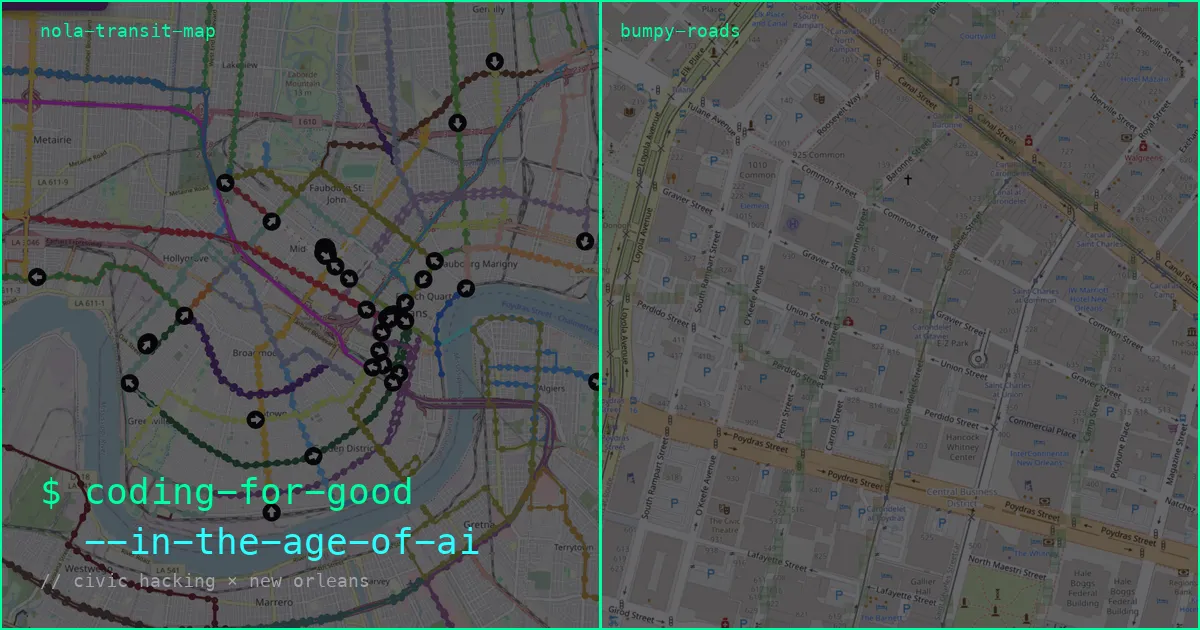
Civic hacking has been around for a while. It’s the action of taking data and building software to make your city and country better. It comes in many forms. In New Orleans we have a grassroots dev community Slack channel with a civic hacking channel. Although it’s been quiet recently, the biggest project to come out of that is a live dashboard of the buses and streetcars. Even with similar functionality being added to the local transit app, still to this day people prefer to refer to the map. Seeing where the streetcar is in real time adds a layer of trust over the ETA shown in the app.
Depending on where you live it might be harder to find problems than others. But take a look around when you’re moving around your city or place. Do you see people at the bus stop wondering when their next bus will be? Maybe the bus is always late. How do they push their case that the buses need improving? A lot of it comes down to data. Many transit agencies publish realtime transit APIs. But that data isn’t being stored. What if you could store that data and find the time and place the bus always seems to be getting delayed? You could then go to your city council and local news and argue for a bus lane to be put there.
If you’re a builder you can already see how that would be fun to make with AI. Build a scraping service, debate with your coding agent on how to handle and store the data for analytics. Database Model Context Protocol (MCP) providers have changed the game a bit for data analytics. Where you once had to craft the perfect query for your dataset, Claude Code + others will eat those queries for their breakfast. You can download the 311 dataset for New Orleans right now and ask your agent “How many issues were reported with bike lanes last year?” and get an answer in seconds.
And if you’re an engineer, what a fun coding project to do by hand. How are you going to detect schedule adherence patterns for where that bus gets delayed? There are fun algorithmic problems out there to be solved.
We’re all feeling the crunch and a lot of us are losing our passion for this industry. If that’s you right now I would say look around and see who you can help. Most problems in the world can’t be solved by software, but there’s more than enough for all of us to try.